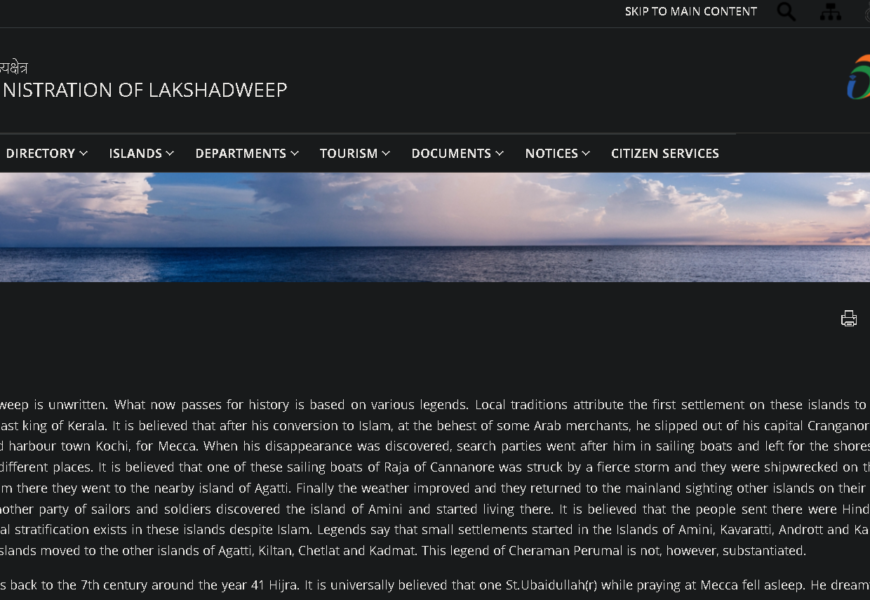
The History of Lakshadweep section on the Lakshadweep Administration’s official website provides an overview of the historical background and significant events that have shaped the Union Territory of Lakshadweep. Here’s a summary of the key points typically covered in this section:
Overview of Lakshadweep’s History
- Geographical Context:
- Lakshadweep is an archipelago consisting of 36 islands located in the Arabian Sea, off the southwestern coast of India. The name “Lakshadweep” means “a hundred thousand islands” in Sanskrit.
- Early Inhabitants:
- The islands were originally inhabited by people of diverse ethnic backgrounds, including those of Dravidian and Arab descent. The early settlers engaged in fishing, agriculture, and trade.
- Trade and Cultural Exchange:
- Historically, Lakshadweep was an important stop for maritime trade routes between the Arabian Peninsula and the Indian subcontinent. This led to cultural exchanges and the introduction of various influences, including Islamic culture, which became predominant in the region.
- Colonial Era:
- During the colonial period, the islands came under the control of the British Empire. The British established administrative structures and introduced changes in governance and trade practices.
- Post-Independence:
- After India gained independence in 1947, Lakshadweep was initially administered as part of the larger state of Kerala. In 1956, it was declared a Union Territory, allowing for more direct governance by the central government.
- Development Initiatives:
- The government has undertaken various development initiatives in Lakshadweep to improve infrastructure, education, healthcare, and tourism, while also preserving the unique cultural heritage of the islands.
- Cultural Heritage:
- The islands have a rich cultural heritage, influenced by their history of trade and settlement. The predominant religion is Islam, and the local culture reflects a blend of indigenous traditions and Islamic practices.
- Modern Era:
- In recent years, Lakshadweep has focused on sustainable development, promoting eco-tourism, and enhancing the quality of life for its residents while preserving the natural beauty and biodiversity of the islands.
Importance of Understanding Lakshadweep’s History
- Cultural Identity: Understanding the history of Lakshadweep helps in appreciating the unique cultural identity of the islands and their people.
- Historical Significance: The historical context provides insights into the socio-economic development of the region and its strategic importance in maritime trade.
- Informed Governance: Knowledge of historical events can inform current governance and development policies, ensuring that they are sensitive to the cultural and historical context of the islands.
Conclusion
The History of Lakshadweep section serves as an informative resource for anyone interested in learning about the rich historical background of the islands. It highlights the evolution of Lakshadweep from its early settlements to its current status as a Union Territory, emphasizing the cultural and historical significance of the region.
Visited 42 times, 1 visit(s) today